

Permit are called “the fish of a thousand casts” because they’ve earned it. Spooky enough to vanish if you sneeze in the boat. Selective enough to refuse a fly that looks perfect to you and eat a beat-up pattern ten casts later. Smart enough to remember the flies that fooled them last season. Even when you do everything right (and we mean everything) success rates hover around 6%. One fish landed for every seventeen shots.
That’s the industry average across destinations from the Florida Keys to Belize to the Seychelles. Not us bragging, just the data.
We’re not going to tell you permit fishing gets easy. It doesn’t. Not here in Xcalak, not anywhere. But our guides have spent years fishing Chetumal Bay’s flats, and after a few thousand blown shots, a few hundred landed fish, and more refusals than anyone wants to count, they’ve figured out the best way to approach these elusive fish. These aren’t theories from fly fishing magazines. This is what actually works when you’re standing on the bow in the ready position with a permit cruising toward you and about three seconds to get it right.
Get the Fly Close Enough That the Permit Can Actually See It
Every permit guide will tell you this, and every angler will nod along, and then most anglers will still cast too far away. It’s the most common mistake because it goes against your instincts. Permit have exceptional eyesight. They detect leader glint, they spook at sudden movements, they’re famously wary in shallow water. Your brain says play it safe, give them space, don’t blow the shot.
But if you cast too far, the permit never sees your fly. You’ve chosen stealth over visibility, and the fish swims past your perfectly placed fly that’s sitting three feet outside its field of vision. You didn’t blow the shot: you never had one.
The distance you need is close enough that one of two things happens: the permit eats the fly, or it speeds away spooked. That’s the target. Most anglers are comfortable spooking one fish out of ten to get an eat. You need to be comfortable spooking nine. Good anglers accept this trade-off. Great anglers have made peace with it.
Practice helps. Set dinner plates on your lawn at forty, fifty, sixty feet and cast weighted flies into them. Not near them, into them. Do this in windy conditions. Do this with a hundred feet of fly line piled at your feet and someone yelling directions. That’s what permit fishing feels like, and if you can’t hit a stationary plate in your backyard, you won’t hit a moving fish on a rocking boat with trade winds blowing.
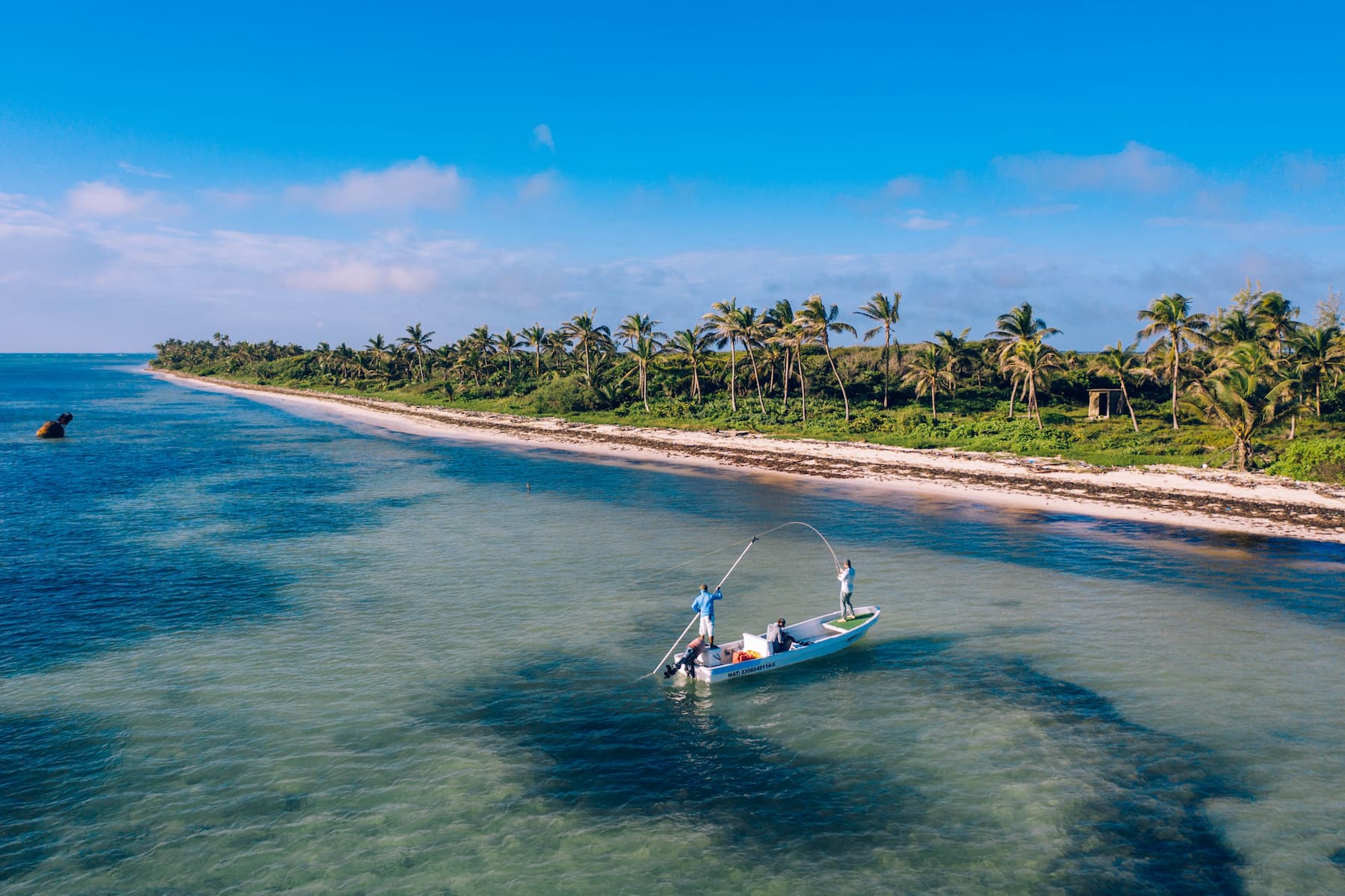
Here’s where Xcalak’s flats give you an advantage. Most permit destinations offer two, maybe three shots per day. You can’t afford to risk spooking fish. But on Chetumal Bay, you’ll often see groups of fish throughout a good day (sometimes singles, sometimes small schools). Our guides teach clients to be aggressive. Go for it. The worst outcome is you spook one permit and wait for the next shot. The worst outcome of playing it safe is you never give yourself a chance.
Del Brown, the legendary permit angler who landed more than 500 in his lifetime, used to say there’s no such thing as a small permit: all permit are permit. Whether you’re targeting a 5-pound fish or a 20-pound trophy, the approach stays the same. Get close enough to be seen.
Stop Moving the Fly (And Watch for the Eat)
Real crabs don’t swim like baitfish. They hide, they burrow, they scurry a short distance and freeze. If you’re stripping your fly the way you’d work a Clouser for bass, permit will refuse it instantly.
After the cast, strip in just enough slack to feel a strike – line tight enough to detect the take but not so tight you’re dragging the fly across the bottom. Then let it sit. Let the fly sink. Maybe give it a tiny twitch. Then let it sit again. This is a patience test. Most anglers fail it because doing nothing feels wrong when a permit is fifteen feet away cruising toward your fly.
Watch the fish, not the fly. When a permit tips down to feed (head angled toward the bottom, tail breaking the surface) your fly needs to be waiting there motionless. If the permit starts to “vibrate” – body quivering as it crushes something on the bottom – set the hook. That vibration means it’s eating whether you felt anything or not.
Xcalak’s shallow flats make this even more critical. You’re not punching flies through five feet of water column. You’re dropping them gently a few feet from a permit’s face in two and a half feet of crystal-clear water. The lighter your fly (bead chain over lead dumbbell eyes), the slower the fly sinks, the more natural it looks settling toward the sand and turtle grass – the food sources permit are keyed in on. Our guides tie most permit flies light for exactly this reason.
If you think you’re stripping too slow, you’re probably still stripping too fast. Catching your first permit often comes down to resisting the urge to do anything at all.
Use a Strip-Strike, Not a Trout-Set
This is where trout anglers lose permit. You see the fish tip, you might feel weight on your fly rod, your muscle memory kicks in, and you raise the rod skyward the way you’ve done ten thousand times on rivers. The fly pulls right out of the permit’s open mouth, and the fish is gone.
Permit feed with their mouths open. They have crushers in their throats, not teeth in their jaws, so they don’t need to close their mouths around prey the way trout do. They grab a mouthful of crab and sand, crush the crab with their throat teeth, and blow the debris out through their gills. The whole time, their mouth stays open and water keeps flowing through.
When you raise the rod (a trout-set) you’re pulling the fly backward through an open mouth at high speed. There’s nothing to catch on. You’ve helped the fish eject your fly.
A strip-strike is different. Long, firm pull with your line hand while the rod tip stays low and pointed at the fish. This drives the hook point into tissue instead of yanking it backward. Once you feel solid resistance – that’s the hook setting – then lift the rod to fight the fish. Make sure your reel has a sealed drag that can handle sudden runs. A 15-pound permit will test your knots and your drag setting in the first thirty seconds.
The motion isn’t violent. You’re not trying to break tippet. Firm, smooth pressure. Come tight to the fish, feel the hook catch, then get your rod up and hold on.
If you miss the hookset with a strip-strike, your fly only moves six or eight inches. It’s still in the feeding zone. Permit often come back for a second look. If you miss with a trout-set, you’ve ripped the fly three feet toward the boat and the permit is gone.
Our guides on Chetumal Bay see this mistake constantly. Anglers who’ve spent years fishing trout streams have to reprogram muscle memory that’s deeply ingrained. The good news: when you get multiple permit shots per day instead of one shot per week, you get more chances to practice the right motion until it sticks. Your first permit trip shouldn’t be about perfection: it should be about learning what works in the right place with the right conditions.
Practice Casting in Wind Before You Arrive
Trade winds blow across Xcalak’s flats most of the year. Sometimes fifteen miles per hour, sometimes twenty-five, occasionally calm enough to make you think you’re somewhere else. Strong wind is part of permit fishing, not an exception to it. You don’t get to choose when permit show up, and they don’t care about wind direction.
Casting heavy flies in wind is not like casting woolly buggers on a trout stream. The fly wants to hit you in the face. The wind wants to collapse your loop. You need tight line control, clean double-haul technique, and enough practice that you’re not thinking about mechanics when a permit appears. Want some help figuring out how to do this? Check out our Prepping for Salt Water Fishing page – we have several video tutorials on how to cast into the wind, perfect your double haul, and more.
Most guides recommend a 9-weight rod, some prefer a 10-weight. The rod weight matters less than your comfort with it. Get a floating line with a weight-forward saltwater taper and practice at home with this exact setup (rod, line, weighted flies) in wind. Not just calm evenings in your backyard. Find a windy day, go to a park, and work on fifty-foot casts from awkward angles. Cast with wind at your back, into your face, quartering from left and right. Get comfortable with wide-open loops that won’t tangle mid-air. Minimize false casts: two to three at most before you deliver the fly.
If you show up to Xcalak without wind practice, you’ll spend the first two days figuring out what our guides already know: technique that works in calm conditions falls apart when you’re trying to punch a weighted Raghead into twenty knots of northeast breeze. You’ll spend a lot of time untangling fly line from yourself instead of fishing. By the time you’ve adjusted, half your week is gone.
The guides position the boat to give you the best wind angle when possible, but permit don’t always cooperate. You need to be able to cast competently in any condition because the fish will show up when they show up, and if you can’t deliver the fly, all the other tips don’t matter. Permit are widely considered one of the most difficult fish to catch on fly, and wind management is part of why.
Learn to Spot Permit Before You Cast
The best cast in the world doesn’t matter if you don’t see the fish. Sight fishing for permit means training your eyes to find them on the flats before they’re close enough to spook, and that’s a skill most anglers underestimate until they’re standing on the bow scanning empty-looking water while the guide is pointing at a permit twenty feet away.
Permit don’t show up like bonefish. They don’t cast the same kind of shadow on light-colored flats, and they prefer slightly deeper water with darker bottom (turtle grass, mixed sand and mud) where they blend in better. You’re looking for specific visual cues, and the more time you spend on the flats, the faster your brain learns to process them.
Tailing fish are the easiest to spot. Dark forked tail breaking the surface, sometimes dorsal fin showing too. The fish is locked onto the bottom, head down, actively feeding. This is your best scenario because you know exactly where the permit is and what it’s doing. Cast close – within a few feet of its head – because its field of vision is limited when it’s tipped down.
Cruising fish are harder. Look for the dark band that runs down a permit’s back from head to tail. When a permit is swimming toward you head-on, that band is visible even when the rest of the fish blends into the background. As the fish turns, it can seem to disappear and reappear depending on the angle. This is why guides talk about permit “appearing out of nowhere” – they were always there, you just couldn’t see them until the angle changed.
One of the biggest things the guides in Xcalak look for is what they call “nervous water.” On calm mornings especially, permit often give themselves away before you ever see the fish itself. Instead of blending naturally with the surrounding chop or wind ripples, cruising permit create subtle V-shaped pushes and wakes that move differently across the flat. Once your eyes learn to recognize it, nervous water starts to stand out immediately—a quiet signal that fish are moving. Many first-time anglers spend the day looking for fish, while experienced guides are often looking for movement first.
Mud trails give away feeding permit that are moving. Small puffs of sediment in the water, usually in a line, show where a permit has been rooting along the bottom. Follow the trail forward and you’ll often find the fish still working that area.
Shadows sometimes show up before the fish does, especially in clear shallow water on bright days. You’re not looking at the bottom: you’re looking slightly above it, scanning for movement or the outline of something that doesn’t belong.
Our guides will call out position and behavior: “Permit at two o’clock, forty feet, tailing, not moving.” Good anglers process that information and get into casting position fast. New anglers freeze up trying to locate the fish, and by the time they see it, the angle is wrong or the fish has moved. This gets easier with practice, but you can speed up the learning curve by understanding what you’re looking for before you arrive. When in doubt though, listen to the guides and follow their direction, even if you can’t see what they see yet.
A good day on the flats means seeing a lot of permit and getting multiple chances to read fish behavior, adjust your approach, and refine your technique. A great day means converting one or two of those chances into hooked fish. There’s no guarantee you’ll land anything on your first permit trip, but you’ll leave understanding why people spend years chasing these fish.
On Xcalak’s flats, clear water and good light conditions give you an advantage for spotting fish compared to muddier or rougher destinations. You’ll still need to train your eyes, but the visibility helps, especially when you’re learning the difference between a permit cruising, a permit tailing, and a permit that’s about to spook because you just made too much noise on the casting deck.
Permit fishing rewards preparation, punishes mistakes, and never offers guarantees. That’s what makes landing one feel like an actual achievement instead of something you checked off a list. Our guides on Xcalak’s flats have the advantage of volume (multiple permit encounters per day, not per week) which means they’ve refined techniques through repetition that most anglers don’t get. When you fish with them, you’re learning from people who’ve seen thousands of permit, landed hundreds, and blown enough shots to know exactly what went wrong and how to fix it next time.
Ready to put these permit fly fishing tips into practice? Book your trip to The XFlats.